
Best Online Casinos for Real Money in Canada 2026 For...
Read MoreProfessional Writing Guide for Persuasive Speech
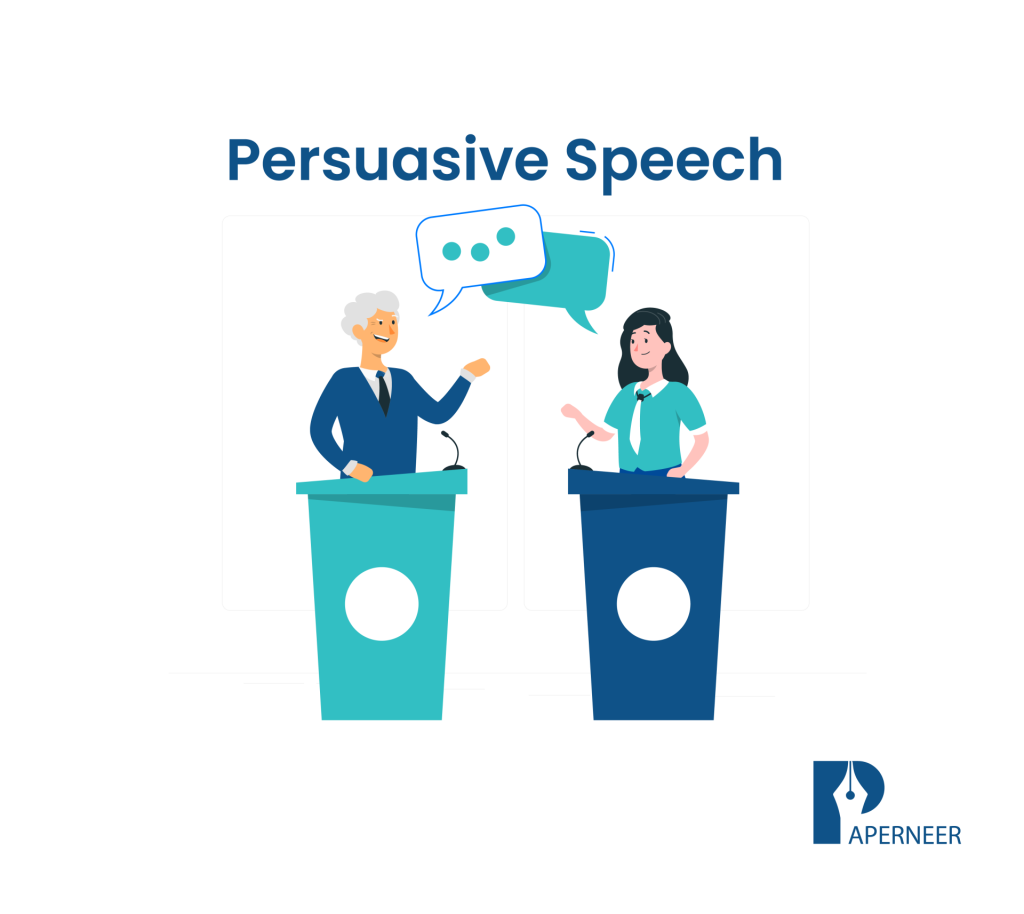
To master the art of persuasive speech, one must have enough credible knowledge to deliver to his audience. Credible knowledge helps the speaker to get convincing power, and the audience will automatically assent to what the speaker says. Persuasive speech starts with arguing about politics, social issues, cultural taboos, etc. A professional writing guide for persuasive speech can better help you understand its nuances and write your own speech. Therefore, this blog is going to provide you with a professional writing guide for persuasive speech and an example of it.
In this blog, you will find:
What is a Persuasive Speech?
This type of speech aims to influence the audience’s beliefs, thoughts, and actions. It involves powerful and compelling arguments that can be backed by evidence. For a more effective approach, you can refer to a writing guide for persuasive speech. For example, if you want to convince your audience to start reducing the use of plastic, you will then have to provide them with proper, valid logic on how plastics are harmful. It would be best to back your argument with logic, compelling quotes, statistics, and emotional aspects.
Characteristics of Persuasive Speech
An excellent persuasive speech has some characteristics that can make it compelling and convincing. The main characteristics of persuasive speech are as follows:
- A persuasive speech must have a well-defined purpose or aim. It should be clear whether the speaker wants to influence the audience’s behavior, their action, or change their opinion.
- It should have a solid and compelling thesis statement around which the whole argument would revolve.
- The speech has to be coherent and in a logical sequence.
- Arguments, logic, statistics, facts and figures, and credible expert opinions should back your speech.
- It should also contain counterarguments to refute them and strengthen the original argument.
- The speech should contain emotional, logical, and ethical appeals to enhance persuasion.
- The speech should contain a clear call to action urging the audience to take specific actions or adapt their behavior.
- The speaker has to repeat the key points several times with an emphasis to add reinforcement.
Persuasive Speech Structure
The basic structure of a persuasive speech is the same as that of any essay or speech. It contains an introduction, two or three body paragraphs, and a conclusion. However, the content differentiates speeches from essays.
A well-structured outline for your speech can help you better convince your audience. A basic structure or outline of a persuasive speech is given below:
- Introduction: The introduction consists of a hook, a brief background of the topic, and a clear thesis statement. The hook mostly contains an interesting anecdote or a shocking statistic. The background will give a short description of the topic of the speech, while the thesis statement will give a brief outline of the main points of the speech.
- Body: The body consists of two to three paragraphs about the topic. The paragraphs have to be strong enough to achieve the goal of the persuasive speech. They will contain compelling or credible facts and figures (Ethos), logical arguments (Logos), and emotional appeal to the audience (Pathos).
Credible sources and knowledge base should back the content of the body paragraphs.
- Counterarguments: The counterarguments should also be given an account or touch. This will enhance the speaker’s credibility. People are always influenced when they know both sides of the story. The speaker can quote the opposite views and then use all his logical proofs and grounds to refute those views.
- Conclusion: The conclusion will recap the key points of the whole speech to emphasize them. Furthermore, it will give the audience a call to action, urging them to take certain actions.

How to Start a Persuasive Speech?
Here are some tips and tricks that can help you to start your persuasive speech:
- Start your speech with a famous quote. It will assist you in setting the tone for your speech.
- In an attempt to start your speech, you can also make use of a rhetorical question to engage and understand your audience.
- Make a shocking statement involving a shocking fact or figure unknown to your audience. This will help you keep your audience attentive throughout your speech.
- Use a “what if” scenario to make your audience follow your thought process.
Persuasive Speech Example for Students
The underlying speech sample is for academic students, as it discusses the importance of education and academic degrees for professional life.
Introduction
Today, I want to discuss the value of education and degrees, a topic that has a huge impact on our future prospects and our ability to succeed professionally. Education remains essential for personal and professional growth in a rapidly changing world where sectors and career paths are constantly evolving. While there are other ways to succeed, a college degree is still precious in the workplace. Let us tell you why degrees and education are more critical than ever.
Body: Education as the foundation for knowledge and skills development:
Above all, education provides a solid foundation of information and skills essential to today’s workforce. A degree from an academic institution implies years of intensive study, analytical thinking, and real-world application. Everything from business to arts, engineering to medicine requires specialized knowledge that can only be acquired through formal education. Conversely, a medical background gives you the skills to properly diagnose and treat patients, while an engineering background gives you the technical knowledge to design and build complex systems.
Additionally, education develops essential skills such as communication, analytical thinking, and problem-solving, which employers value because they are necessary for navigating today’s complex job market. Investing in education allows people to gain more knowledge in their chosen field and become more adaptable to different opportunities and obstacles.
Academic Degrees as a Source of Opportunities
A college degree also opens up many professional opportunities. You may need a degree in many industries to climb the career ladder and land an entry-level job. For example, legal, medical, and academic jobs often require advanced degrees and specific credentials.
People may feel that their job opportunities are limited and that they will not be able to pursue their chosen profession if they do not have the required academic credentials.
In addition, considering academic graduation certificates, you can significantly increase the possibility of acquisition. Research has consistently demonstrated that people with high educational levels probably earn more money than those in high school.
Earning a degree increases your initial earning potential and opens the door to higher-paying jobs and leadership positions within organizations.
Despite the conventional view emphasizing the value of education and a college degree, formal education is not the only path to career success. In fact, there are many compelling arguments against making decisions based solely on degrees. One must possess practical experience in theoretical knowledge, and alternative education models should also be implemented.
Conclusion:
In conclusion, formal education and degrees have historically played an essential role in career advancement, but there are other ways to succeed in the workplace.
Achieving career goals can be facilitated by various educational methods, real-world experiences, and changing labor market demands. As it moves, people need to recognize and evaluate various approaches that people can use for information and abilities necessary for success other than normal educational conditions.
What are Some Good Persuasive Speech Topics
- The Current Chaos in the World is due to Politics
- Planting, A Dire Need of the Time
- A Good Nation Can Build a Prosperous Country
- A Raise in the Minimum Wage is the only Solution for the Working Class
- Breaking the Gender-Identified Roles
- Mental Health Awareness: The Key to a Happy Society
Best Interac Casinos for Speedy & Secure Payments 2026
Best Interac Casinos for Speedy & Secure Payments 2026 Content...
Read MoreInterac Casinos Best Sites That Accept Interac 2026
Interac Casinos Best Sites That Accept Interac 2026 For the...
Read More